Part 10 · 7 min read · Published
Sovereign AI Roadmap & Real Economics
A four-phase path from pilot to production, and the two-cost-shape math that tells you when owning beats renting.
TL;DR
- Sovereignty is a threshold you cross on a use case at a time, on the strength of a measured cost slope and a real operating model — not a big-bang migration and not a logo.
Everything so far has been the what. This article is the how do we actually get there and the does it actually make sense. Because the last thing a CEO or CTO needs is a beautiful architecture that's the wrong economics for the company they're running.
The path: don't rebuild the world on day one
Phase 0 — Audit & baselines. Before buying a GPU, measure. What's the current per-token bill and its growth slope? Which use cases have steady, growing volume? What's the data-residency exposure per workload? Where are the traceability gaps? This is where you find your threshold. Skip it and you'll buy capacity for the wrong workload — the most common sovereign-stack mistake is capacity without a mandate.
Exit criteria: a written shortlist of 1–3 candidate workloads, each with volume, sensitivity, and current cost. If you can't produce that, you're not ready for Phase 1.
Phase 1 — One use case, end to end. Pick the single highest-volume, highest-sensitivity workload and build the full stack around just that — inference, data, orchestration, trace. You want the whole spine working for one job, not a half-stack across ten. This de-risks the architecture cheaply and produces a real, measured baseline.
Exit criteria: one use case in production, with a working trace and a measured cost per request. Not "in staging" — producing value.
Phase 2 — Productionize + trace. Make it real: observability goes from "we logged a little" to "we can reconstruct any request." Production means the cost ledger, the audit trail, and the guardrails are all live. This is the phase that turns a pilot into something you're allowed to run on customers.
Exit criteria: a trace you can hand to a regulator or a board and have it stand up; a cost ledger that matches the bill.
Phase 3 — Scale + specialize. Now you earn your keep: add fine-tuned models for the tasks that benefit, route the long tail to small models, and let the index compound. This is where retrieval quality and per-request cost improve together — and where the "moat" from Article 5 starts to show in the numbers.
Phase 4 — The operating model. Capacity planning on a schedule, model-governance reviews, entitlement re-checks, a named owner (Article 9). Sovereignty is maintained here, or it quietly leaks. A stack that's shipped and then abandoned is not a stack — it's a slow leak.
The economics: two cost shapes, not two prices
| Dimension | Renting (per-token) | Sovereign (owned) |
|---|---|---|
| Cost at low volume | Low (vendor absorbs fixed cost) | Higher (you carry the fixed cost) |
| Cost at high volume | Rises with usage; can change | Falls per request; stable |
| Price / policy changes | At the vendor's discretion | You control |
| Data residency | Vendor-controlled | In your perimeter |
| Traceability | Vendor-mediated | Full, end to end |
| Capacity | Vendor-managed | You plan & right-size |
| Change a model / policy | Request + wait | You ship |
| Lock-in | High | Low |
| The asset you build | None | A compounding index + cost ledger |
The two columns aren't "cheap vs. expensive." They're two different cost shapes. Renting is a variable cost with hidden optionality — someone else can move the price. Sovereignty is a fixed cost with your optionality — you can move the behaviour, the model, the policy. The crossover is where your volume makes the fixed cost per request fall below the rental bill's trajectory.
A worked example from the reference estate
These figures are the estate's own hardware and power math — not a customer quote. Capex on the path: two bare-metal inference nodes at €5 000 each, a €300 interconnect, and €5 000 of supporting servers and networking (€15 300 total), plus ~€100/month power. Amortised over three years that is ~€525/month all-in before any human ops line. At always-on utilisation near the generation ceiling (and counting prompt + completion the way a vendor bill does — roughly three times decode-only), the pool clears on the order of ~1.6B tokens/month. The internal price of intelligence lands near €0.33 per million tokens. That is the flat line.
| Scenario | Monthly | ≈ per M tokens |
|---|---|---|
| Owned pool (reference) | €525 (capex amort. + power) | ~€0.33 / M |
| A — rent baseline (20% Sonnet / 80% Opus) | ~$16 900 | ~$10.7 / M |
| B — rent high / extra-high (20% Sonnet / 80% Fable 5) | ~$31 700 | ~$20 / M |
Read the shape, not just the euros. Scenario A is already roughly thirty-to-fifty times the owned monthly line at this volume; scenario B is sixty-to-ninety times. One month of the Sonnet/Opus mix covers more than the entire €15 300 capex. Hardware, power, and utilisation will move — what must stay true in your version is the geometry: (a) the rental line has a slope (volume and list price both move against you), and (b) the owned line is flat and you control it. When the rental slope overtakes that flat line on a per-token basis, ownership stops being an ideology and becomes arithmetic. And the owned column accumulates what renting never will: an in-perimeter index and a cost ledger. In the reference estate that ledger is generated at the gateway — every call metered at one hop — so the internal price of intelligence is a query, not a finance project.
When sovereignty is not the right answer
I'd rather be straight about this than sell you a stack. Sovereignty is the wrong call when:
- Volume is spiky or experimental — you're paying for silicon that's idle most of the time. Rent the spikes.
- The data is low-sensitivity and the workflow a quick, one-off experiment — the fixed cost isn't justified yet.
- You can't staff the operating model — a sovereign stack with no one watching utilization and re-testing policy is a slow leak, and a well-run rental is safer than a poorly-run sovereign.
The pattern that usually wins is hybrid — and it's worth saying plainly that the reference estate itself runs this way: a fully in-perimeter core (identity, AI control plane, inference, the data plane, the business spine), with selected external services at the edges where control is not at stake. Own the steady, sensitive core; rent the spikes and the experiments; review the threshold quarterly against your real volume and the vendor's real pricing. That's not a compromise — that's the disciplined version.
The decision, in one line for the board
Own the workloads where volume is real, sensitivity is real, and cost is a trend line you want to stop watching. Rent everything else — for now, and review the line quarterly.
That's the whole strategy. It's not "all or nothing." It's "cross the threshold deliberately, on a use case at a time, and own the thing you can prove you own."
The bottom line of the series
Sovereign AI isn't about ideology and it isn't about a logo. It's four properties — cost control, data residency, traceability, policy control — delivered by an architecture where the model is the least interesting part and the planes around it are everything. If you can trace a request, meter its cost, classify its data, and change its behaviour without a vendor's consent, you don't need the word "sovereign" to describe what you have.
And if you can't yet — that's just Phase 0.
End of series.
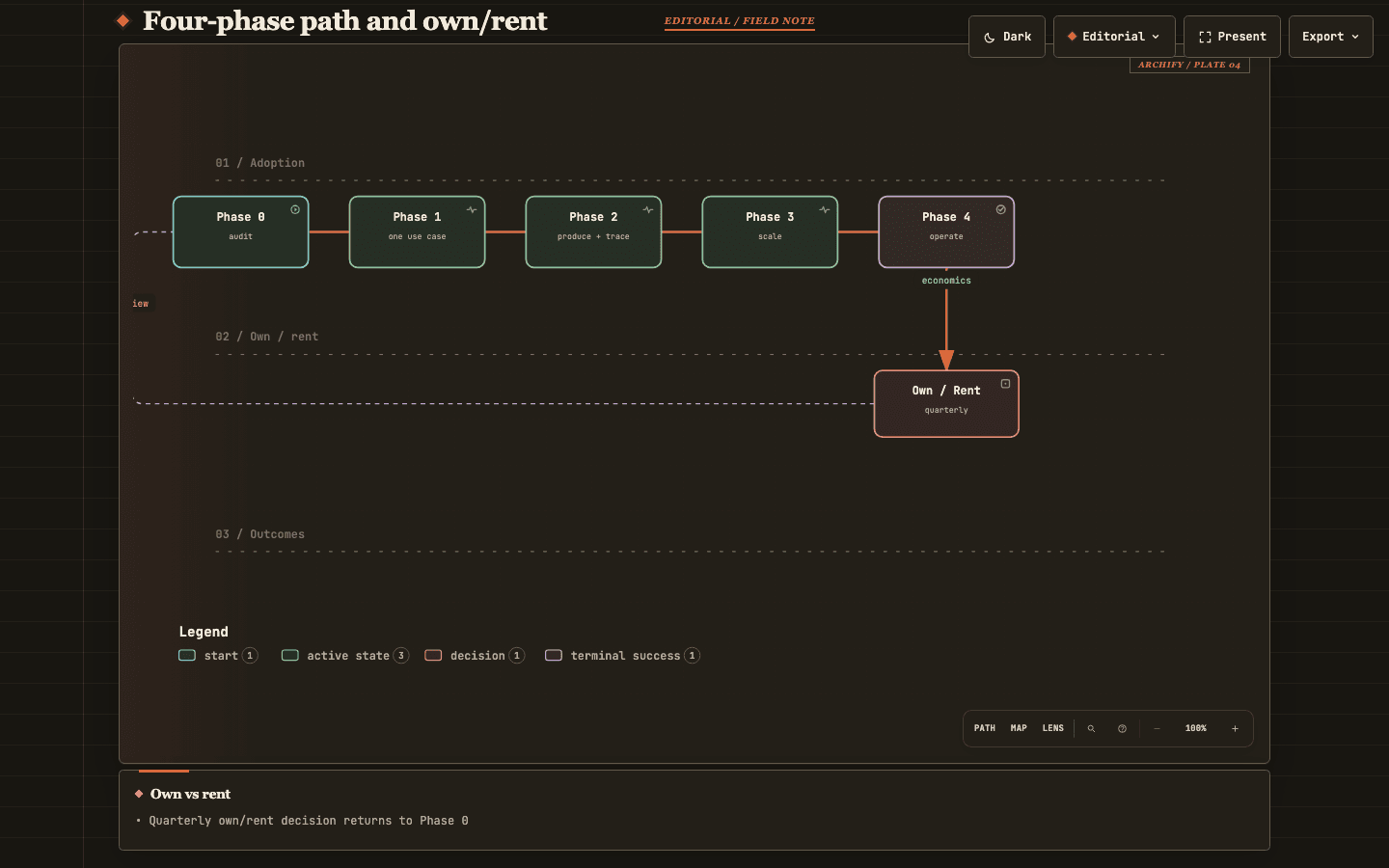
Caption: Sovereignty is a threshold you cross on a use case at a time — on the strength of a measured cost slope and a real operating model.
Part 10/10