Part 05 · 5 min read · Published
Your Data Never Leaves: The Sovereign Data Layer
"Data stays home" is either an architectural fact or a press release. Here's the three-part test that tells the difference.
TL;DR
- "Data stays home" is either an architectural fact — ingest, retrieval, and generation all in-perimeter — or a press release. If any one of the three hops out, you have a pipe, not a plane.
The most repeated claim in sovereign AI is also the most easily faked: your data stays in-house. It's a single sentence, and it can be true — or it can be a promise about where a copy is stored while the actual processing happens elsewhere. For a CTO, that sentence is worth a full architecture review.
The honest version of the claim has three parts
All three must be true, not just the first:
- Ingestion is in-perimeter. The moment your documents, records, and query data enter the system, they're processed inside your boundary. No "send it up, embed it, send it back."
- Retrieval is in-perimeter. At query time, the act of finding relevant context happens against your index, on your storage.
- Generation is in-perimeter. The model that turns that context into an answer runs on your compute.
If any of the three hops outside, the sentence is only partly true. This is the single most important test in the whole series, and it's the one most "connected to data" pitches quietly fail.
The data plane, end to end
Read the arrows: source systems → ingest & normalize → classify & PII-redact → chunk & embed → (vector store + data lake) → query-time retrieval → grounded answer → delivered to the requester. Every step from source to grounded answer is inside the box. The only thing that leaves the perimeter is the answer itself — which is exactly what you'd want.
Ingestion is a pipeline, not an upload
The step most teams treat as "just copy the files in" is where a data plane is won or lost. Ingestion has to:
- Normalize heterogeneous sources — PDFs, tickets, code, structured rows — into a clean, consistent form. A table split across a page boundary, or a ticket body with embedded formatting, degrades retrieval if it's not handled.
- Track lineage — which source document each chunk came from, when it was last updated, its version. Without lineage you can't answer "where did that answer come from," which is the whole point of a grounded system.
- Handle the delta — what's new, what changed, what was deleted — on a schedule, so the index doesn't silently drift. A stale index is a confident-wrong index.
Classification happens before storage — and that's the control
Not everything in your corpus is the same. Some of it is public marketing. Some is internal process. Some is customer PII that a downstream answer must never quote verbatim. A sovereign data plane classifies each record at ingest and lets policy decide what a model is even allowed to retrieve.
This is where "data residency" stops being a storage location and becomes a control. It's also where sovereignty and governance become the same conversation instead of two vendors: the classification that security needs and the retrieval that quality need are the same label, read by the same policy engine, at the same chokepoint. (Article 9 wraps that into the security story.)
And PII is handled at this step, not after the fact: detect it, then redact it, tokenize it, or wall it off from certain classes of requests — before it ever reaches a prompt. "Never quote a customer's phone number" becomes a testable rule, not a prompt-box prayer.
The index is a moat, not a liability
A vendor's API has no memory of you. Every call is priced fresh, and the vendor's model has no idea what your company sounds like. But your in-perimeter index — built from your own records, tuned to your own vocabulary, classified to your own risk model — is an asset that gets more valuable the longer you run it. You've built a retrieval layer no competitor's generic model has. That's the compounding value a per-token bill never gives you, and it's the argument that survives the "but renting is cheaper today" objection: you're not just cutting a cost, you're accumulating something.
The failure mode to design against: the "connected to data" trap
It's easy to bolt a vector search onto a rental model and call it sovereign. But if the model still runs externally, or if the embedding step phones home, you've moved the plumbing, not the control. The test is simple and brutal:
Trace one request and tell me, byte for byte, where it went.
If you can't, you don't have the data layer yet — you have a data pipe. And a pipe that leaks is worse than no pipe, because it gives you the confidence of "we're connected to our data" without any of the control.
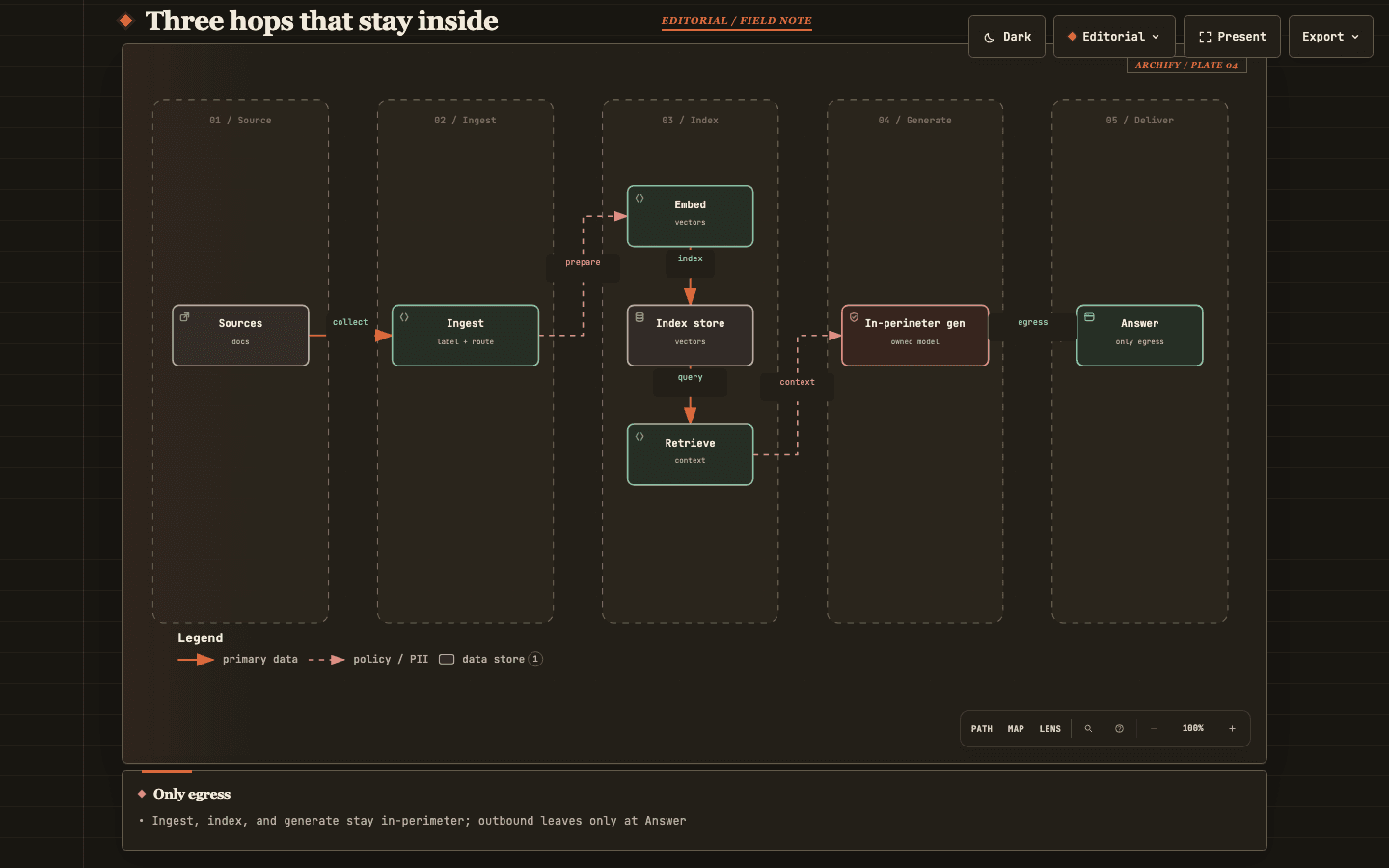
Caption: Ingest, retrieval, and generation all in-perimeter — or it's a press release.
Next: from "connected to data" to "actually using it well" — the RAG layer, done right, and where the real quality comes from.
Part 5/10
Next article · Part 06
RAG Done Right: Where the Real Quality Comes From →