Part 07 · 5 min read · Published
The Orchestration Layer: Where Control Lives
Prompts are versioned behaviours, guardrails are policy, models are swappable. The orchestration layer is the seam where sovereignty lives.
TL;DR
- The model is a component; the orchestrator is the system. Prompts are versioned behaviours, guardrails are policy (not suggestions), models are swappable behind one interface, and every agent step is traceable — or it's a liability.
Strip away the marketing and a raw model is just a function: in you give text, out it gives text. It has no idea what your company is, what a customer is allowed to see, or what "good" looks like for your use case. The orchestration layer is everything between your business and that function. It's where sovereignty stops being about hardware and starts being about control you can actually see and change.
Four responsibilities, each a place you'll want to control
1. Prompt versioning is configuration management. The prompt — the instructions that shape the model's behaviour — is not a string hardcoded in an app. It's a versioned, reviewed, deployable artefact. When a prompt changes, you want to know which version a given answer came from, who approved it, and when. The failure mode is subtle and expensive: someone edits a prompt to fix one edge case, it quietly changes the behaviour of five other workflows, and no one knows which version was live during the incident. A prompt is a behaviour. Version it, review it, and deploy it like one — with the same traceability you'd give a code change.
2. Guardrails run before and after the model. Before: the policy checks from Articles 5 and 9 — what data may this request even touch, is this user allowed here, does the retrieved context pass entitlements? After: what may the answer say — PII that should be redacted, is a refusal the right response, does the output match the expected shape? The key architectural point: guardrails are policy, not prompt-box prose. "Don't quote PII" enforced by a redaction layer that runs after generation is a control; "please don't quote PII" in the system prompt is a suggestion the model may or may not honour. Sovereignty means the difference between those two.
3. Multi-model is the operating norm, not a special case. The orchestrator decides the router's choice (Article 4). A draft email goes to the fast small model. A contract analysis goes to the big general one. A task you've fine-tuned goes to the specialist. The orchestrator treats models as swappable components under one interface — which is precisely the lock-in you don't want. If Model B underperforms next quarter, you re-point the route; you don't rebuild the app. That's the seam between "renting behaviour" and "owning behaviour."
4. Agents and workflows live here — and they're where traceability matters most. The moment a task needs more than one model call — retrieve, draft, verify, retry, escalate — you're in workflow/agent territory. Note the bounded retry and the escalation path: an agent that can't say "I'm not confident, route this to a human" is a liability, not a capability. And because every step is a span in the trace (Article 8), you can reconstruct why the agent took step four. A multi-step agent that can't explain its own decisions becomes, in a real incident, the thing you can't defend.
The strategic point for a CTO
The orchestrator is your seam, and seams are where control lives. Every line of business logic that touches AI crosses this layer. That means every policy, every version, every routing decision, and every guardrail is visible to you and changeable by you — without touching the model, and without touching a vendor. Invest in this layer before you spend on another GPU: more silicon doesn't fix an orchestration layer that can't version a prompt, enforce a guardrail, or explain a decision.
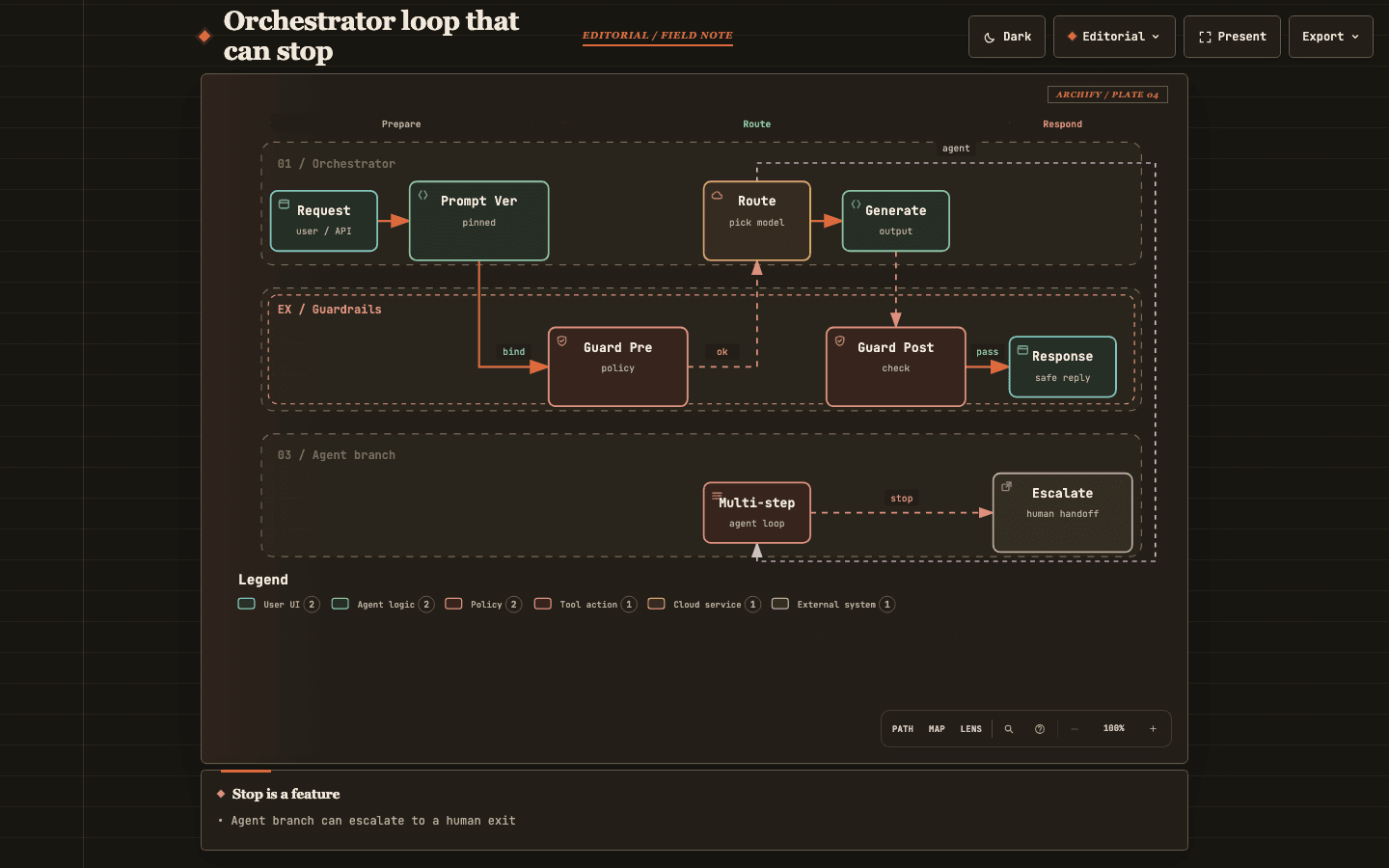
Caption: Prompts are versioned behaviours; guardrails are policy, not suggestions; models are swappable; and every agent step is a span — or it's a liability.
Next: traceability — the layer most sovereign pitches skip, and the one your board will actually ask about.
Part 7/10
Next article · Part 08
Trace Everything: Observability as a Board Feature →