Part 08 · 5 min read · Published
Trace Everything: Observability as a Board Feature
You can't defend a sovereign stack you can't trace. Traces, logs, and the cost ledger are the answer to the question the board will ask.
TL;DR
- A sovereign stack you can't trace is a liability you can't defend. Traces, logs, and the cost ledger are the answer to the one question the board will actually ask — and you can't bolt them on later.
Here's the question that ends a lot of "but we're self-hosting, so we're sovereign" conversations:
"Show me what happened with that customer's data last Tuesday."
If the answer is "well, the model saw something, I think," you don't have sovereignty. You have a system you trust but can't prove. Sovereignty, for an enterprise, is only as strong as its ability to reconstruct the past. Every request should be replayable: who asked, what was sent, which data was retrieved, which model answered, what came back, what it cost, and who was allowed to see it.
That's not optional observability. It's the core of the promise. And it's the layer most "sovereign" pitches skip, because it's unglamorous — and because it's the part a vendor-mediated setup structurally can't give you.
Three streams, one record
Traces. Every request becomes a trace — a chain of spans, one per step: gateway → orchestration → retrieval → routing → inference → response. Each span records its name, its start/end, and its inputs and outputs. This is how you answer "why was this one slow" and "which step failed." It turns a black box into a timeline you can read. In a multi-step agent (Article 7), the trace is what lets you see the whole decision path, not just the final answer.
Logs. The prompt, the completion, and the metadata around them — stored immutably with retention you define. Not sampled. Not "we keep some." This is the raw record. And because it's in-perimeter, what's stored, for how long, and who can read it are your policy decisions, not a vendor's data-handling terms.
Metrics. Latency, tokens in/out, cost per request, model utilisation. This is the stream that feeds the cost model — the thing that makes sovereignty an economic decision instead of a hope. You can now point at a single feature and say exactly what it costs to run, and watch it bend as you scale.
Audit. The decision record: who was allowed, what class was touched, what was redacted, which prompt version was live. This is the stream that feeds compliance, and it's what turns a control from "we have a policy" into "here is the log proving it ran."
A trace, made concrete
Here's what one trace for a single retrieval-augmented request actually contains (values illustrative):
| Span | Model / step | In (summary) | Out (summary) | Cost | Latency |
|---|---|---|---|---|---|
| gateway | — | authed call, user u-4821, class support | accepted, key k-114 | $0.0000 | 4 ms |
| orchestrate | — | prompt v14 + user turn | plan: retrieve → generate | $0.0000 | 2 ms |
| retrieve | — | query, top-k=50 | 3 chunks, sources doc-8821, doc-1093 | $0.0000 | 31 ms |
| route | — | task=summarise | model C-small | $0.0000 | 1 ms |
| inference | C-small | prompt v14 + 3 chunks | 214 tokens | $0.0004 | 480 ms |
| guardrail.post | — | output | PII check: pass; shape: pass | $0.0000 | 9 ms |
That table is the difference between a claim and a record. It's also, notice, a cost ledger in row form — every step metered, attributable, and summable.
Two things this plane unlocks that a rental can't
1. The cost ledger is yours. Because every request is metered in-perimeter, you build a true internal price for your own intelligence. You can attribute cost to a team, a feature, or a customer. You can set budgets and alert when a workflow drifts. A vendor can give you an invoice; it can't give you this. This ledger is also your negotiating spine — the moment you know your real cost, a vendor's price hike stops being a surprise and starts being a decision.
2. Compliance becomes a query, not a project. "Prove no PII left the perimeter." "Show every access to records in class C." "Reconstruct the decision for request #4471." In a traceable stack these are queries against your own store, answered in minutes. In a rented setup they're emails to a vendor and hope. For the data under regulatory pressure, that difference is the difference between a control you can demonstrate and a control you can only assert.
The design principle: build it in, or you can't build it later
Traceability is a first-class requirement, not an afterthought bolted on at the end. It has to be in from the first line of the orchestrator, because you can't retro-instrument a system that never recorded the spans in the first place. The immutable store, the retention policy, and the per-step metering have to exist before the first production request, not after the first audit request.
Build it in, and sovereignty is provable. Skip it, and you've built an expensive black box and called it freedom.
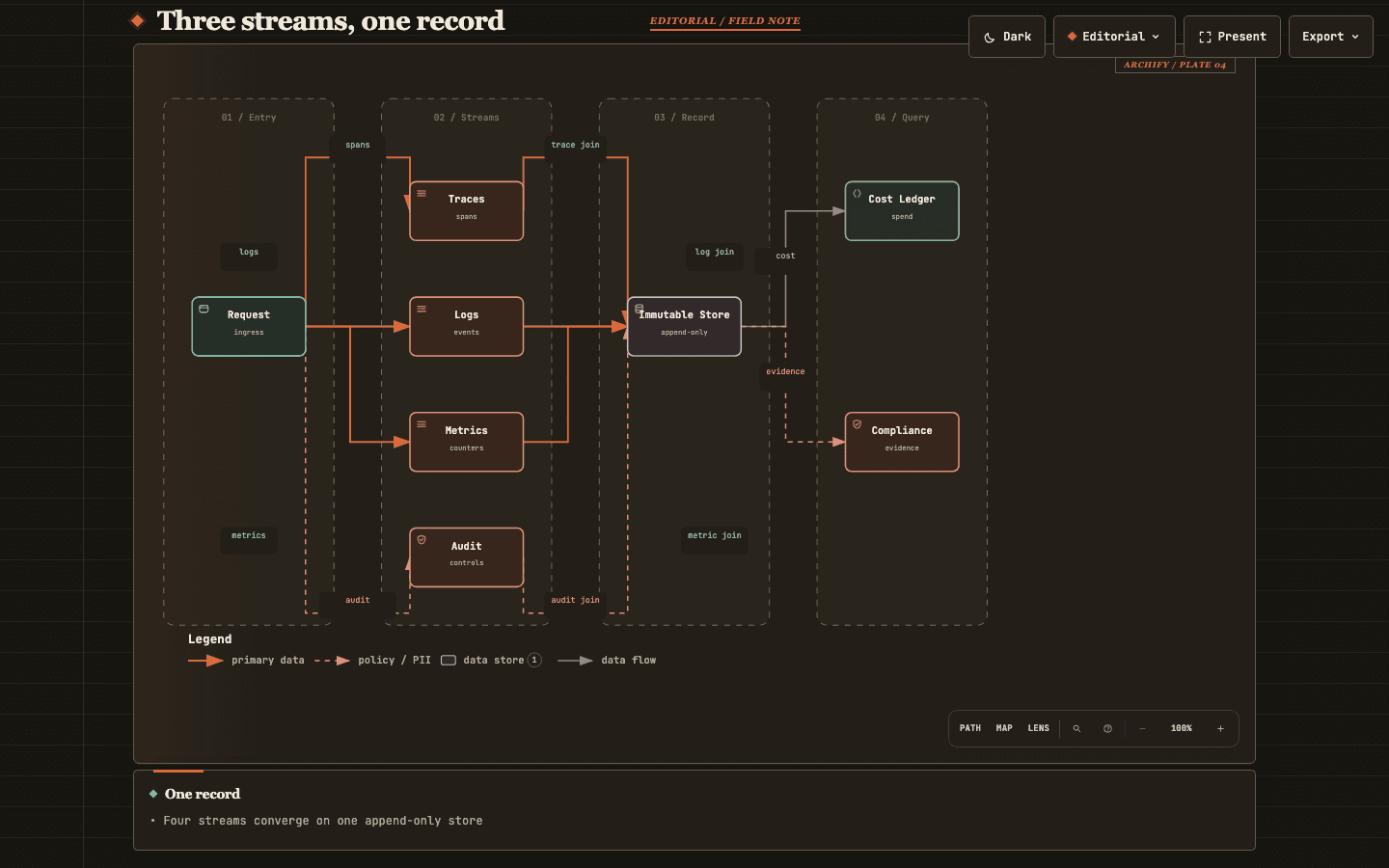
Caption: Traces, logs, metrics, audit — converging on the one store the board will actually ask about.
Next: security and governance — the controls that make "in-perimeter" more than a location.
Part 8/10
Next article · Part 09
Security & Governance in a Sovereign AI Stack →