Part 09 · 5 min read · Published
Security & Governance in a Sovereign AI Stack
"In-perimeter" is a location, not a control. The governance wrapped around it — and the named owner who keeps it from leaking.
TL;DR
- "In-perimeter" is a location, not a control. Sovereignty is only as strong as the governance wrapped around it — and governance needs a named owner and a review cadence, or it leaks.
Moving your AI in-house is not, by itself, a security improvement. It's a relocation. A locked room is only as secure as the doors inside it. The whole point of a sovereign stack is that you now control the doors — and you're now responsible for them. That responsibility is the security and governance plane, and it's where "we're self-hosted" becomes "we can actually defend this."
Four controls, in the order a request meets them
1. Identity and least privilege, at every hop. Every internal service authenticates the next (mutual TLS between services is the baseline — service-to-service mTLS, not just a token at the edge), and every caller gets only the access their role requires. A support agent's queries and a data-science team's queries go through the same gateway but with different entitlements. This is service-level access control — the granularity a shared external API simply doesn't expose. On a rented API, your whole team shares the vendor's identity boundary. In-perimeter, each hop is a boundary you draw. And because it's logged to the audit trail (Article 8), "who could have called this" is a query, not a guess.
RBAC vs ABAC, plainly. Role-based (RBAC) is "users in role X can read class Y." Attribute-based (ABAC) adds conditions — "and only if the request's data class ≤ the caller's clearance, and within region Z." Most serious deployments start with RBAC at the edges and move to ABAC where the policy is conditional. The point for a CTO isn't the acronym — it's that the policy lives in your perimeter, and is versioned and audited.
2. Classification drives everything downstream. From Article 5, each record carries a class. That class is what the policy engine reads to decide what a model may retrieve and what an answer may contain. Governance and security are the same mechanism here: one classification, enforced by one policy, at one chokepoint. That's the elegant part of doing it in-perimeter — the control and the enforcement live in the same place, instead of in two products that have to be kept in sync by hand.
3. PII handling is explicit, not assumed. Detection and redaction happen before context reaches the model and again on the way out. "Never quote a customer's phone number" becomes a testable rule, not a prompt-box prayer. And because it's yours, you can tune it to your data — a vendor's generic PII filter is either too loose for your risk or too blunt for your content, and you can't see its false-positive rate. In-perimeter, you measure it, you tune it, and the measurement is in your own audit trail.
4. The audit trail is the control's memory. Every decision — who was allowed, what class was touched, what was redacted, which prompt version was live — is written to the immutable store from Article 8. For GDPR-style obligations and any regulator who asks how you controlled access, the trail is the deliverable. The control without the trail is a claim; the trail is the evidence. Tamper-evidence (append-only, hash-chained, or signed) matters here — an audit trail that can be quietly edited is worse than none, because it manufactures false assurance.
The part that keeps a sovereign stack honest over time
Sovereignty is a posture you maintain, not a state you achieve. Models change. New data classes appear. A new workflow wants broader access. The governance plane has to be reviewed on a schedule — entitlements re-checked, classification rules tested, PII rules re-validated against real traffic, audit retention confirmed. The stack that ships and then goes quiet is the stack that, eighteen months later, quietly stops being sovereign: someone added an integration, a class was never mapped, a policy was never re-tested.
In the reference estate, this is a named function, not a hope: a standing GRC owner reviews the estate against a documented control set on a cadence, using an in-perimeter GRC platform fed by the same operational documentation the rest of the stack uses. The human owns the cadence; the platform holds the register — not an unsupervised agent rewriting the estate. Governance eating its own dog food, literally.
So who owns this?
The ask of the organisation isn't just "build it." It's: name the owner. Who is accountable for the classification rules, the entitlements, and the audit? In a healthy deployment that's a joint CISO + CTO ownership, with a standing review cadence — because the moment sovereignty has no named owner, it starts to leak. A sovereign stack without a named accountable human is a sovereignty claim without a sovereignty control.
The upshot: the security and governance plane is what makes "your data in-house" defensible under scrutiny. It's unglamorous, it's ongoing, and it's the difference between a claim you make and a control you can prove.
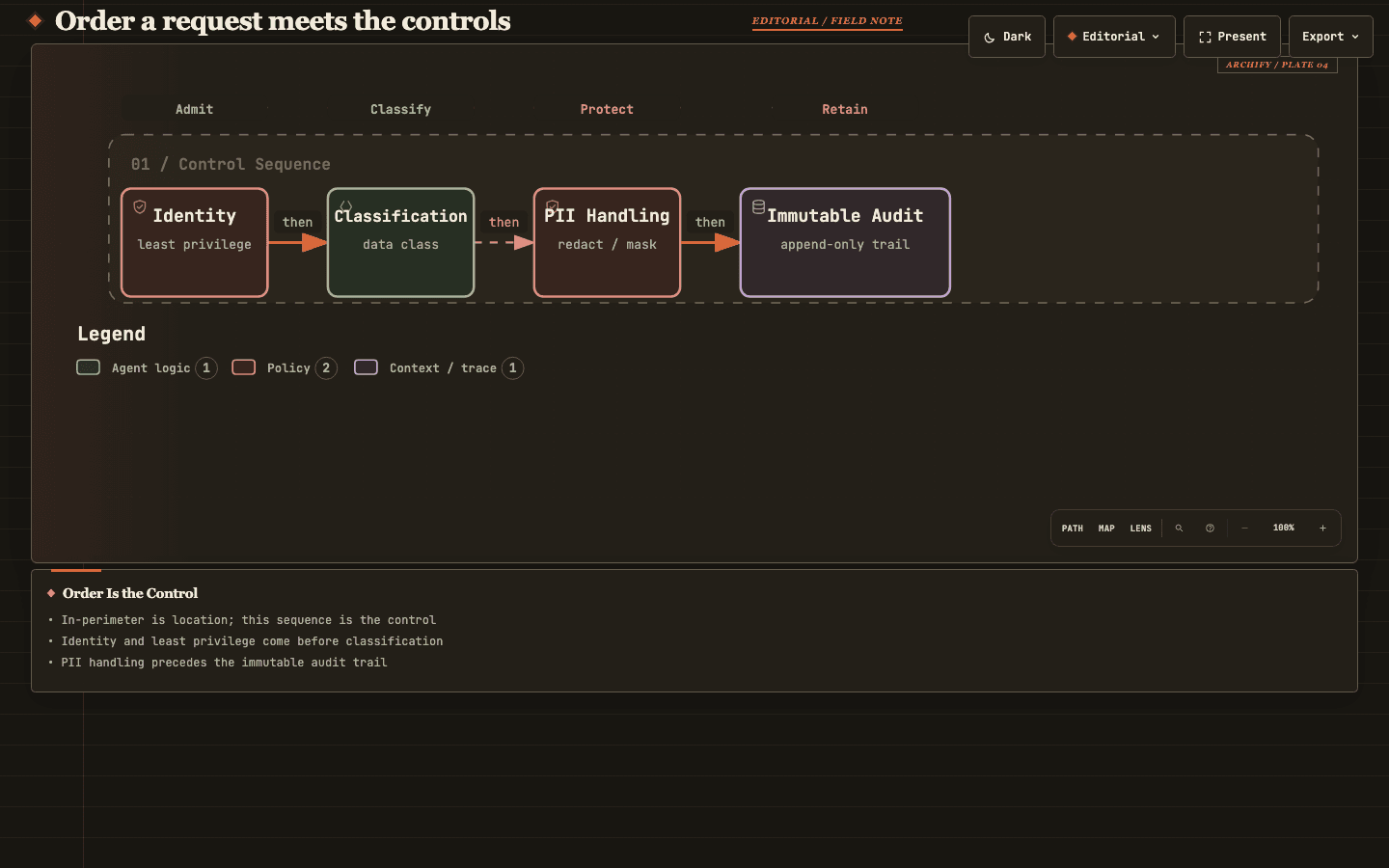
Caption: "In-perimeter" is a location. This sequence is the control.
Next — and last: the roadmap and the real economics. When sovereignty pays, and when it doesn't.
Part 9/10
Next article · Part 10
Sovereign AI Roadmap & Real Economics →