Part 04 · 6 min read · Published
Owning Inference: The Heart of Sovereign AI
Continuous batching, routing, quantization, and right-sizing — the four levers that make in-house inference cheap at scale.
TL;DR
- Inference cost only bends the right way if the engine is engineered for it — continuous batching, memory-aware scheduling, prefix caching, cost-based routing, and measured quantization. One model, one batch, one-at-a-time is not sovereignty; it's expensive theatre.
Everything a sovereign stack promises is ultimately about one act: taking a request and producing a completion, on hardware you own, at a cost you can model. That act is inference. It's the most capital-intensive part, the most performance-sensitive part, and the part where "owning your AI" is either real or theatre.
The single most important idea: the marginal cost of a request should fall as you scale. Rent per-token, and every extra request costs the same — or more. Run inference in-house, and the GPUs are already warm; the next request is nearly free. That's the whole economic argument for sovereignty in one line. The catch: "nearly free" only holds if the serving layer is engineered for it. The difference between an engineered serving layer and a naive one is the difference between a cost that bends the right way and a pile of idle silicon.
The request lifecycle, in a system that's actually tuned
Request in at the gateway → authenticated and metered → context retrieved if needed → routed to the right model → batched into the serving engine → tokens stream back → response plus trace plus cost out the gateway. Nothing about this path is exotic. The four engineering choices below are what make it fast and cheap.
1. Batch it — the single biggest lever on cost-per-request. Modern serving engines don't run one prompt at a time. They run continuous batching: they group many concurrent requests into a single GPU pass, and — the important part — insert new requests into an in-flight batch the moment a GPU slot frees, instead of waiting for the whole batch to finish. A single GPU can therefore serve dozens of simultaneous users, because the silicon — not the request — is the constraint. If your stack can't batch, you're paying for idle silicon and your latency suffers. This is the first thing to verify in any "we self-host" claim: is the serving engine doing iteration-level scheduling, or one-request-at-a-time? The answer determines most of your cost curve.
2. Manage memory so more requests fit in flight. Each request accumulates a key-value cache as it generates — and that cache is what lets the model stay coherent. An engine that manages that cache in paged, non-contiguous blocks wastes far less GPU memory, which means more requests in flight, which means higher throughput on the same hardware. Unglamorous, entirely internal, a real compounding lever — and exactly the kind of thing a black-box API hides from you.
3. Cache what repeats — prompt/prefix caching. Most enterprise traffic is repetitive in structure: the same system prompt, the same tool definitions, often the same retrieved context prefix across a session. An engine that caches the key-value state of a shared prefix skips re-computing it on every request. For a workload with a stable system prompt and a stable tool set — which most of them are — this is a meaningful, near-free cost reduction that a per-token bill will happily bill you for, request after request.
4. Route by cost, not just capability. The router is doing real work. A "summarise this ticket" request and a "draft a legal opinion" request are not the same job. The cheap, fast, quantized model handles the first; the larger general model handles the second. Most enterprise workloads are a long tail of small requests and a short head of hard ones — and routing that tail to small models is where the savings compound. The router is also your lock-in escape hatch: every model sits behind one interface, so swapping a model next quarter is a routing change, not a rebuild.
5. Quantize deliberately. Running a model at lower precision (e.g. 8-bit or 4-bit) fits more of it on the same GPU and speeds it up, at a small, measured quality cost. "We run at 4-bit" is only meaningful next to "we measured quality on task X and it held." It's a choice you make and test, not a number you inherit from a vendor.
The two numbers that tell you if you're healthy
Time-to-first-token (TTFT) — the user's experience of "fast." Steady-state tokens-per-second and GPU utilization — the engine's experience of "efficient." If TTFT is high but utilization is low, you have a routing or batch-filling problem. If utilization is high and per-request cost is falling as volume rises, the engine is doing its job. Watch both, on a dashboard, with alerts. This is the stream that feeds the cost ledger in Article 8.
Right-size the pool — and plan capacity
The GPU pool is sized to demand, not to aspiration, and reviewed on a schedule. Peak season gets more nodes; off-peak sheds them. This is why a sovereign stack needs an operating model, not just a purchase order: someone watching utilization, forecasting the slope, and deciding when the crossover to "add a node" is real. A pool bought for a peak that came once and never again is the classic sovereign-stack waste.
The honest part: owning inference is not free on day one
You're buying the fixed cost — silicon, cooling, platform, and the engineers who keep it fast. A rental bill has none of that at low volume. So the crossover is a numbers question:
- How many requests/month, and at what growth?
- Current per-token bill and its 12-month trajectory?
- Right-sized pool cost at that volume (amortized + power + platform + engineering)?
If the rental slope is steeper than the fixed cost per request, ownership wins — for most enterprise workloads with steady or growing usage, usually within a year. For spiky, experimental, or one-off usage, renting still makes sense. Sovereignty is a threshold, not a religion. (Article 10 makes this a working model.)
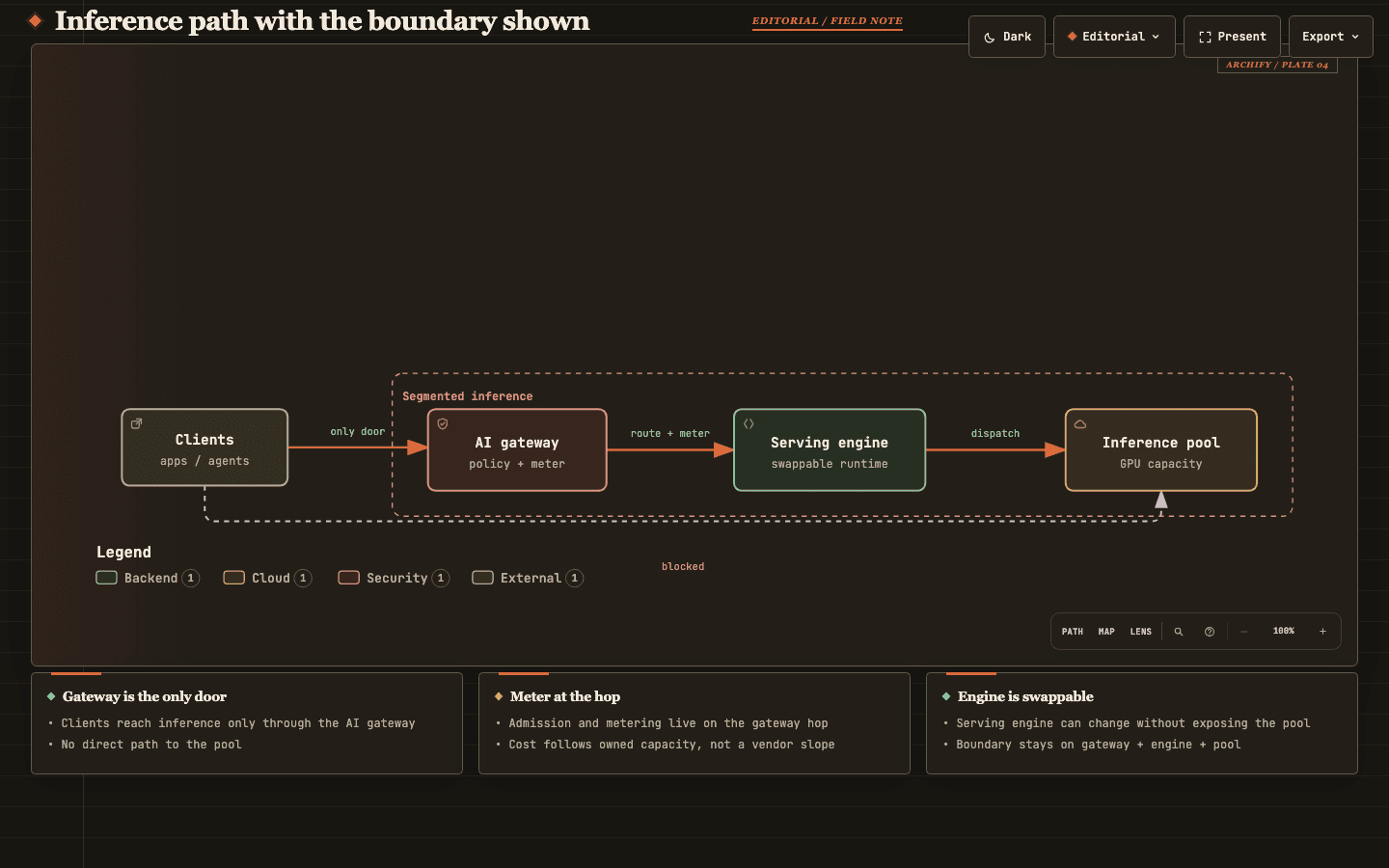
Caption: Clients never aim at raw GPU endpoints. The gateway is the only door into the inference pool — enforced at the network, metered at the hop.
The payoff, once you're past the threshold
Control. You pin the model. You change the behaviour. You stop reading change logs written by someone else. And every request — including exactly what it cost — lands back in the trace we build in Article 8. That last part is the quiet prize: metering in-perimeter is what makes your intelligence an asset you can price, budget, and defend.
Next: the data plane — how your own knowledge becomes the moat, without leaving the building.
Part 4/10
Next article · Part 05
Your Data Never Leaves: The Sovereign Data Layer →