Part 01 · 5 min read · Published
You're Renting Your AI. Here's What It Costs
Renting AI means ceding your cost slope, your terms, and your data. Here’s the threshold where owning starts to make sense.
TL;DR
- Renting AI transfers three things you rarely re-acquire — your cost slope, your terms, and your data. Sovereignty is buying those back, and it only wins past a volume-and-sensitivity threshold.
Most enterprises don't own their AI. They rent it.
You priced a feature two months ago. It used AI to summarise a document, draft a reply, and answer a customer. The cost was acceptable. The margin model worked. Then one of two things happened: the per-token price moved, or a policy on the other side of the API moved. Not both. One was enough. Your unit economics for a feature you've already sold — maybe already contracted — quietly stopped adding up, and you found out from your finance team in a monthly review, three weeks later.
That's the shape of renting your intelligence. And it's worth naming precisely, because the cost is not where most people look for it.
Three costs you didn't sign up for
When you consume AI as an external API, three things are true at once.
Your cost curve is not yours. You pay per token, and the price can be re-set without your consent. At the volumes a serious enterprise feature reaches, this is not a rounding error — it's a line item with a slope. The slope is the problem. A utility has a metered rate you can forecast. A commodity has a market you didn't join, and the price tracks something you can't see.
Your terms are not frozen. Model availability, rate limits, data handling, and acceptable-use policies can all change. A restriction applied "without notice" can disable a workflow your business depends on. You can read the change log; you can't vote on it.
Your data travels. Prompts, outputs, and in many cases context derived from your internal records leave your perimeter to be processed. Some of it is retained. You have a policy to read; you don't have a trace to point to.
None of this is the vendor's fault. It's the structure of the arrangement. And renting is the right choice for a lot of things — for experimentation, it's often the right choice for AI too. But there's a threshold where it stops making sense, and that threshold has nothing to do with ideology.
The threshold is about control, not conviction
The point where renting stops being rational is defined by three questions:
- Is the volume high enough and steady enough that the fixed cost of owning compute amortises to less than the rental trajectory?
- Is the data sensitive enough that "it leaves the building" is a problem you can't paper over with a vendor's data-processing agreement?
- Do you need to prove what happened to a board, a customer, or a regulator — in which case a trace you don't control is a structural gap, not a fixable one?
If two or three of those are yes, the threshold is close. And the threshold is exactly what "sovereign" is trying to describe.
Sovereignty is the alternative: running the same capabilities on infrastructure you control, with open-weight models you can run, update, and pin — and a data plane where your information never has to leave the building.
The three leak points of a rented AI stack
Renting AI transfers three things you rarely re-acquire: your cost slope, your terms, and your data trace.
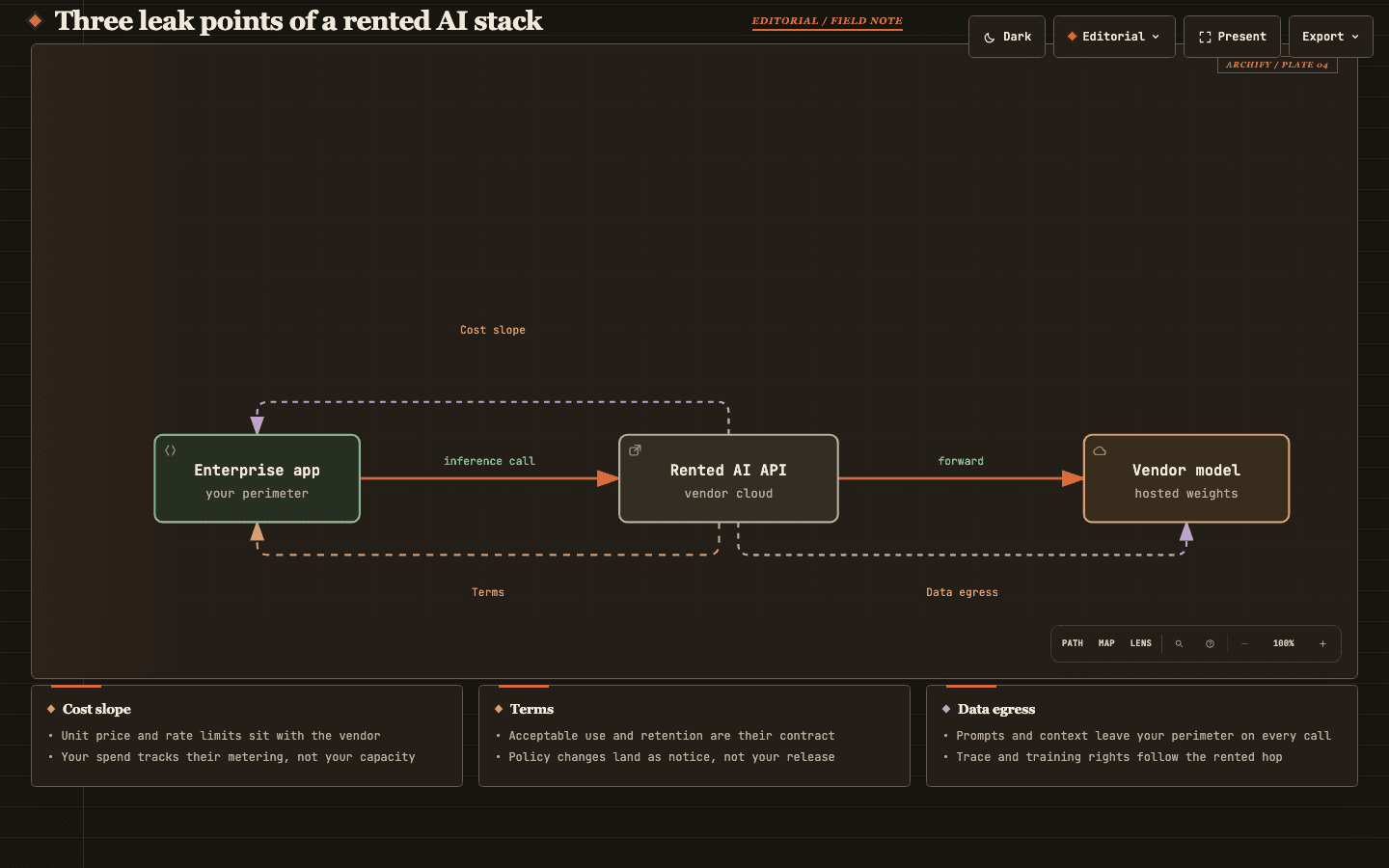
Caption: Renting AI transfers three things you rarely re-acquire: your cost slope, your terms, and your data trace.
The promise is concrete
That phrase — "sovereign" — gets used a lot and means different things to different people. So this series will do two things: define it precisely, and build the actual architecture that delivers on it, layer by layer — compute, data, retrieval, orchestration, and the part most "sovereign" pitches skip: the traceability that lets you prove your data stayed home.
By the end, you should be able to look at a single diagram and see exactly where each byte of your data goes, what every request costs, and who changed a policy and when. That's not a marketing claim. It's an architecture.
Next: what "sovereign" actually means — and the four things a claim must satisfy to deserve the word.
Part 1/10
Next article · Part 02
What "Sovereign AI" Actually Means (and What It Isn't) →