Part 02 · 5 min read · Published
What "Sovereign AI" Actually Means (and What It Isn't)
Sovereign AI means controlling four things: cost, data residency, traceability, and policy. Here’s the test, and what it isn’t.
TL;DR
- Sovereign means you control cost, data residency, traceability, and policy. If a claim can't be mapped to those four, the word is doing decoration.
"Sovereign" has become a loose adjective. It shows up next to private clouds, next to on-premise hardware, next to fine-tuned models, next to data-residency claims that turn out to mean "we store a copy in your region." Before we look at any architecture, the word has to earn its keep — for an enterprise that's about to commit budget and engineering, a decorative word is a liability.
Sovereignty means you control four specific things
Cost. You are not paying per token to a third party whose pricing can move. You pay for infrastructure — a known, planable, right-sized cost — and the marginal cost of an additional request falls as you scale, instead of rising. Your cost curve bends the opposite way from a rental bill.
Data residency. Prompts, completions, retrieved context, and the internal records behind them are processed and stored inside your perimeter. Nothing has to egress to be understood. This is a property of the data plane, not of a checkbox on a form.
Traceability. You can answer, for any request: who asked, what was sent, which model handled it, what context was retrieved, what was returned, and what it cost. Not "probably." A queryable record.
Policy control. You decide which models run, which prompts are allowed, which data classes may be touched, and when a behaviour changes. The terms are yours to version, not yours to accept.
Hold that list. It's the test. A proposal that can't be mapped to all four is using the word decoratively.
The four things "sovereign" is not
This is where most pitches go soft, and where I'd push back hardest.
It isn't automatically cheaper. At low volume, a rental bill is cheap because someone else absorbs the fixed cost of GPUs and idle capacity. Sovereignty shifts that cost to you. It becomes the better economics at volume and over time — but it's a different cost shape, not a lower number on day one. Anyone who promises a lower bill on day one is selling you a story.
It isn't "just self-hosting a model." Downloading a model and pointing a server at it is not sovereignty. Without the data plane, orchestration, and traceability, you've moved the risk, not removed it. The model is the least interesting part of the stack. The planes around it are everything.
It isn't the absence of the cloud. Most serious sovereign deployments still use managed infrastructure, object storage, and sometimes regional hosting. Sovereignty is about control and visibility, not about cutting every external wire. A "no cloud" requirement is usually a symptom, not a goal.
It isn't a one-time build. It's an operating model: capacity planning, model governance, and cost review on a schedule. A sovereign stack left unattended rots like any platform — and quietly stops being sovereign, as integrations get added and policies go un-re-tested.
A spectrum, not a switch
| Posture | What you control | What you don't |
|---|---|---|
| Fully rented | Nothing structural | Cost, terms, data path, trace |
| Hybrid | The steady, sensitive core | The spikes (rented) |
| Sovereign (this series) | Cost, residency, trace, policy | Vendor lock-in (you can swap models) |
The hybrid row is the one most enterprises should start in, and Article 10 is mostly about how to get there deliberately. But the target for the sensitive, high-volume core is the sovereign row — and the four properties above are what "target" means.
Why the four, and not five
You might expect "security" on the list. It isn't, and that's deliberate. Security is necessary but not sufficient: a rented API can be encrypted in transit and still fail all four properties. Security is the wrapper around sovereignty, not a substitute for it. (Article 9 covers that wrapper in detail.) The four properties are the ones a rented setup structurally cannot give you — which is why they're the definition.
From here I'll show the architecture that delivers all four — and in a couple of places I'll deliberately show the seams, because the seams are exactly where the traceability and the cost control live.
Every property maps to a mechanism you can walk through — not a label on a slide.
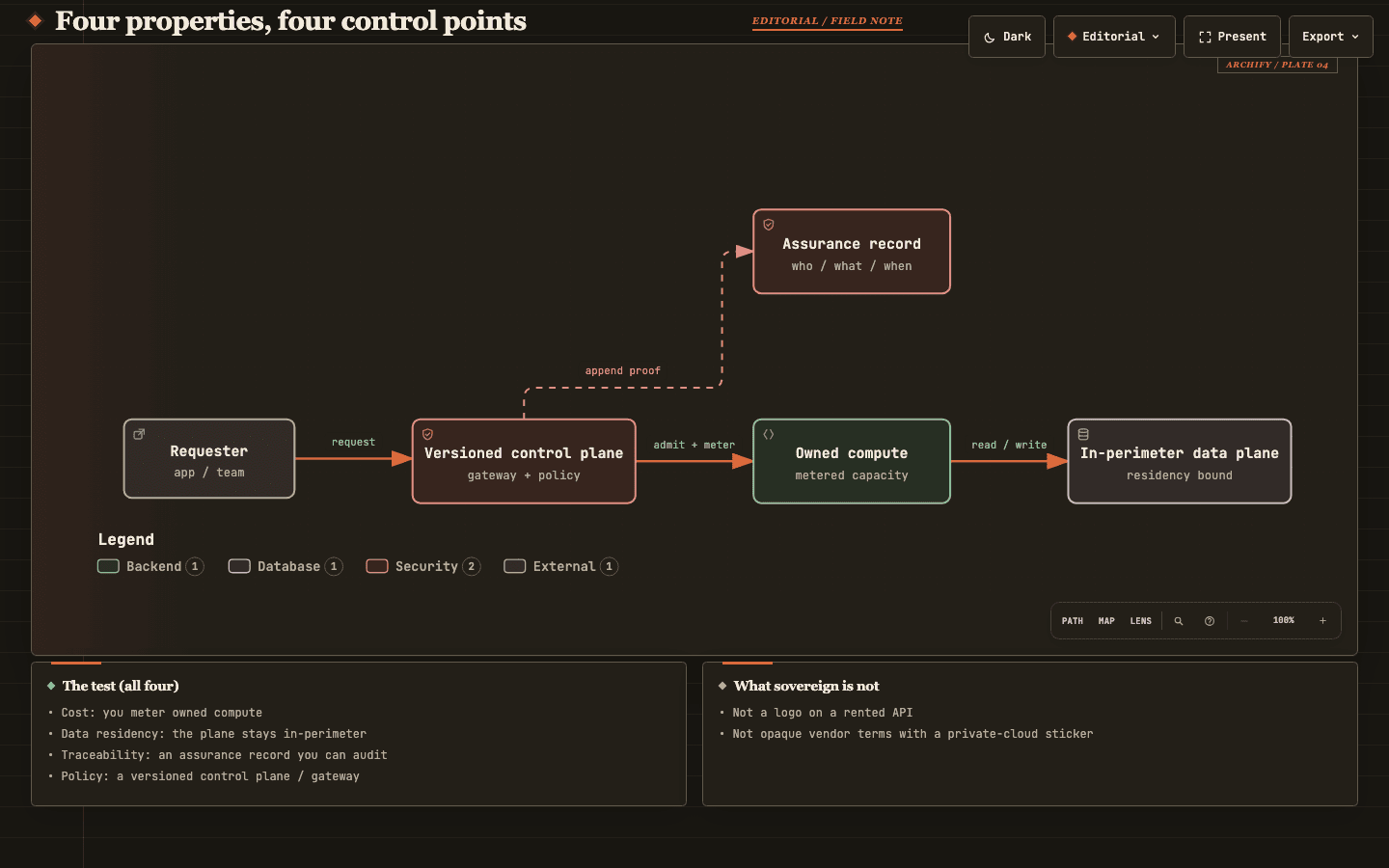
Caption: Every property maps to a mechanism you can walk through — not a label on a slide.
Next: the whole stack at a glance — one diagram, every layer, and the two planes where sovereignty actually lives.
Part 2/10
Next article · Part 03
The Sovereign AI Stack, at a Glance →