Part 03 · 5 min read · Published
The Sovereign AI Stack, at a Glance
One diagram, five layers. The model is the least important part — sovereignty lives in the data and assurance planes.
TL;DR
- The model is the least interesting part. Sovereignty lives in the data plane and the assurance plane — and in the fact that every request is observed on the way down.
Here's the entire stack. Read it top to bottom, and notice the two things that separate a sovereign stack from "a model in a box": the data plane at the bottom and the assurance plane on the side. Those two are where sovereignty actually lives. The models in the middle are, honestly, the most interchangeable part.
The five planes
1. Edge & Access — the front door. One gateway in front of everything. It authenticates the caller, enforces rate limits and quotas, and routes the request. This is where "policy control" physically begins, because every request has to pass through a point you own and can inspect. What matters to a CTO: this is your single chokepoint. You can meter every request here, reject anything unauthenticated here, and log who-came-and-when here. If the gateway is thin or bypassable, the rest of the control story falls over. Treat it as infrastructure-grade, not a thin proxy. In the reference estate there is a second door for operators: a private mesh, with admin planes off the open internet by default — so the front door and the back door are separately guarded.
2. Application & Orchestration — the seam. The layer between your business and the model. It decides what to do: which prompt template, which data to pull, which model to call, whether to chain several calls into a workflow or an agent. The orchestrator is the brain; the model router picks the specific model; the prompt & policy manager holds versioned prompts and guardrails. What matters to a CTO: this is where your control actually lives — the seam every line of business logic crosses, and where behaviour is versioned, governed, and swappable without touching the model. (Article 7 opens this plane.)
3. Inference / Compute — the heart, and the cost. A pool of GPU nodes runs open-weight models through serving engines built for throughput. Two serving paths — a general model and a specialized/quantized one — because that's how you keep cost under control by sending cheap requests to cheap models. What matters to a CTO: this plane is the most capital-intensive and the most performance-sensitive, and it's where "owning your AI" is either real or theatre. In the reference estate the inference nodes are network-segmented — the gateway is the only path to them, which is a firewall rule, not a convention. (Article 4 opens it.)
4. Data & Retrieval — your information, staying home. Your content, staying in the building: a vector store for semantic search, a relational store or lake for structured records, and an embedding service that turns your content into something the models can retrieve. This is where "your data never leaves" becomes an enforceable property rather than a slogan — and where the compounding asset (your own index) is built. Reference estate detail: the estate's own platform documentation is the first corpus in that index — the system knows itself before it knows your customers. (Articles 5 and 6.)
5. Assurance — the side rail you must not skip. The plane that runs across everything: observability (traces, logs, per-request cost), security & governance (identity, PII handling, audit), and the platform that deploys and manages all of it. What matters to a CTO: this is the plane executives under-fund and then regret. In the reference estate it's the continuous health probing of every workload, the SIEM/IDS (host telemetry live; packet mirror still named interim), the vault, the in-perimeter GRC register, and the change gates in the pipeline — and it's the difference between claiming sovereignty and proving it. (Articles 8 and 9.)
Two things to take from the diagram
First, sovereignty is a property of the planes around the model, not of the model itself. You can swap the model in the middle and stay sovereign; you can't buy sovereignty by choosing a better model.
Second, every request flows top-to-bottom and is observed on the way. The dashed lines from the assurance plane are not optional decoration — they're the mechanism that makes traceability and cost control possible at all. A stack where requests flow down but nothing is observed on the way is an expensive black box, and it fails property 3 from Article 2.
In the next four articles I'll open each of these planes in detail. We start at the heart, because that's where the money and the control both live.
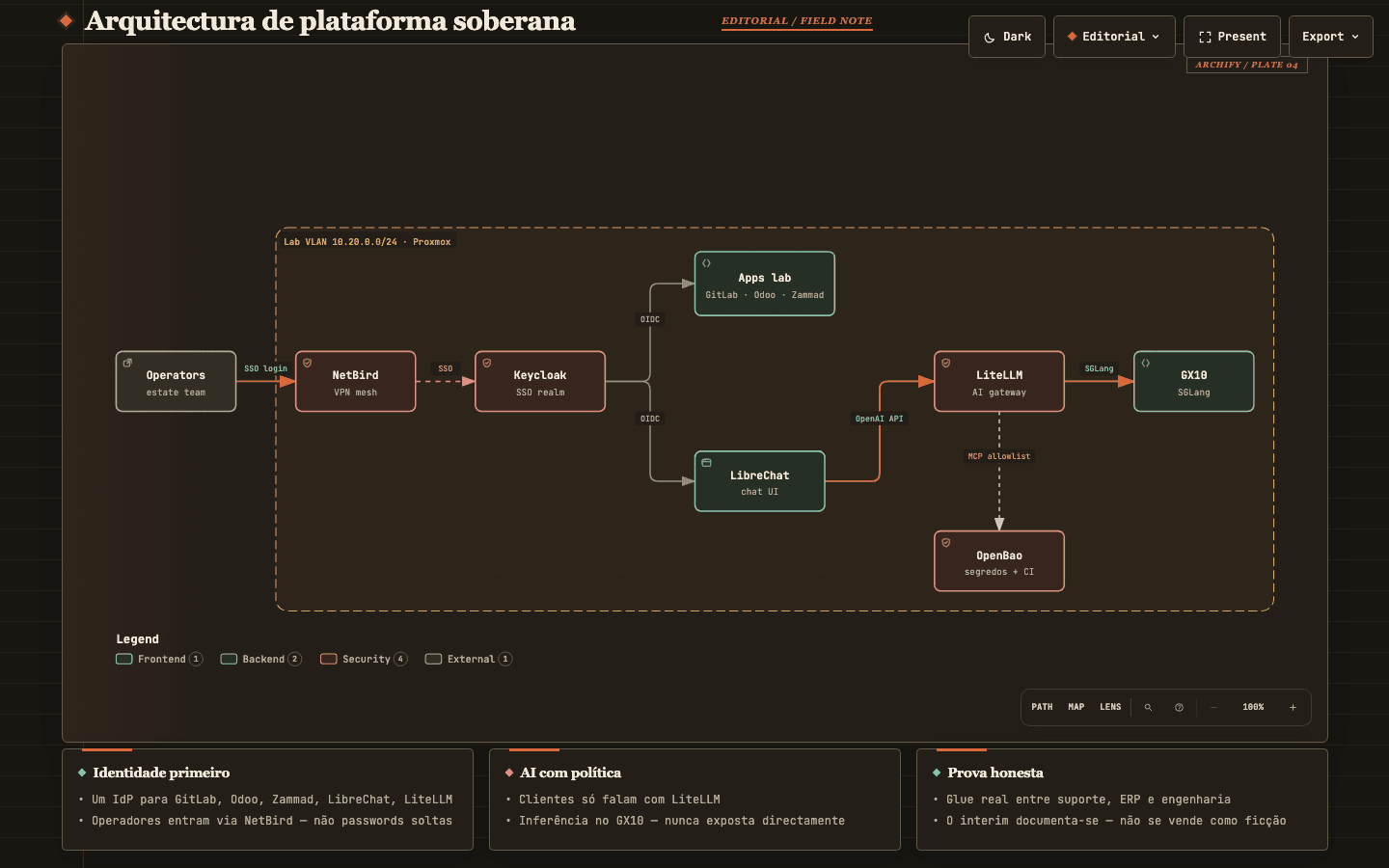
Read top to bottom for the request path; read the gold dashed lines for where sovereignty actually lives.
Next: owning inference — what it actually costs, why throughput matters, and why one model is never enough.
Part 3/10
Next article · Part 04
Owning Inference: The Heart of Sovereign AI →